
This year’s Freedom Day and Human Rights Day were celebrated in the shadow of persistent high unemployment figures, widening inequality and slow service delivery. Despite decades of policy intervention and investment, progress has been uneven and, in many cases, exclusionary. But we could be looking at new avenues for solutions – and one of these is access to data on business conditions.
________________________________________________________________________
Dr Phumlani Nkontwana
Last month South Africans celebrated post-apartheid democracy on Freedom Day. SA still faces challenges like persistent high unemployment and widening inequality. Progress in so many sectors has been uneven and slow. We should be looking at new avenues for solutions – and one of these is increasing and democratizing access to data on business conditions. On 27 April, South Africans commemorated the country’s first democratic elections which paved the way for a new Constitution and a focus on human rights, celebrated the previous month exclusively on 21 March. Yet for the majority of South Africans, there has been little economic freedom, and human rights have been arguably decoupled from prosperity. High unemployment has been a persistent headache for government and citizens. It remains a mystery to me why our many economic policies and programme interventions have not improved the 31% unemployment rate.
Jobs, Jobs, Jobs!
Lately, I haven’t been into a social or formal conversation that has not involved jobs. People are looking for well-meaning, well-paying and sustainable jobs. But for new quality jobs to occur, we need more newer, growing and innovative firms. For newer, growing and innovative firms to occur, we need talented individuals to imagine and drive such innovative (ideally some also including R&D based ideas) high-impact ventures. Needless to say, these individuals need to be well supported with an enabling policy environment (including digital and physical infrastructure). Put together, these are the conditions widely cited by many scholars as an ‘ecosystem’.
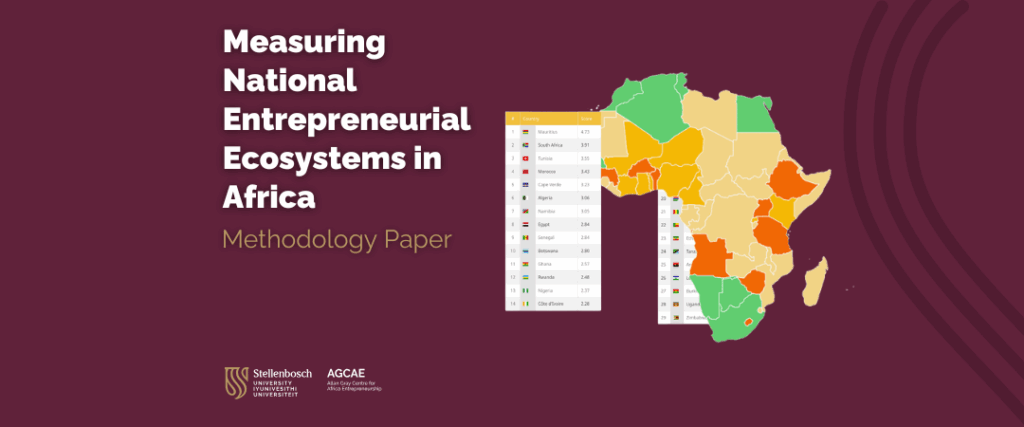
I will not bore you with the academic wordsmithing and technical differences between ‘entrepreneurial’, ‘business’ and ‘innovation’ ecosystems. For the purposes of this conversation, I use the term ‘ecosystem’, as we use it in the Africa Entrepreneurial Ecosystem Index paper, to refer to necessary conditions we need to create enabling environments for talented entrepreneurs and new innovative firms to thrive. ‘Data’ on these conditions refers to the information, evidence or related observations helping us take stock of how the ecosystem is evolving over time. A type of data that goes beyond snapshots, cross-sectional analyses or even once-off glossy industry or country reports.
It is only through good long-term views where access to ecosystem data can make a meaningful difference. In South Africa we are not there yet. We have made great strides in economic industry data (see for example the amazing work of TIPS to name just one significant effort) and in some cases, ambitious government-led innovation policy data efforts like NACI. But these efforts are either too niche to existing industries or not easily accessible to entrepreneurs and ecosystem builders who need it most. It has become widely known how access to data can shape economic and entrepreneurial outcomes. Ecosystem data can be a driver for improved policy, investment opportunities, better orchestrated networks and business partnerships.
In South Africa the previous two months, specifically Freedom Day and Human Rights Day offered us an opportunity to reflect not only on the rights we have secured, but also on those we have yet to fully recognize. In an increasingly digital and data-driven world, the right to access, understand and use ecosystem data is fast becoming one of them. As a country we have incredible history in advocating and protecting ‘human’ rights such as gay pride, women’s rights, children’s rights, freedoms to vote, freedoms to move; to name just a few. This short essay makes the argument that one of the rights we also need most is access to ecosystem data to help illuminate pathways to decent jobs – ultimately the human right to enable ease of investment decisions, ease of matching founders with targeted non-financial and financial support, and at the right stages of venture progression.
Well curated and creatively governed national data can become an ecosystem clinic we need to pin-point support gaps and opportunities. We need to seriously consider making this a core human right in a world of big data and artificial intelligence (AI). We cannot fully realise the fullness of AI, machine learning and data mining with pockets of individual datasets that only provide pieces of the puzzle and not a stylised ecosystem intelligence story.
How can access to data make a difference?
Elsewhere on the continent, we have examples of how it can work. In Rwanda, for instance, there was the AGUKYA/YouthConnekt Tracer Study Report, in which close to 2000 entrepreneurs were surveyed and assessed from 2022 to 2025. The report showed that in 90% of cases of job creation, there was a spillover effect in communities, boosting entrepreneurial activity in retail, transportation, food vending and construction sectors.
There are local examples as well. The 2025 iLembe Entrepreneurial Ecosystem Mapping Report shines a spotlight on the entrepreneurial landscape of a key tourist area in KwaZulu-Natal. Despite real tourism potential, the region has patchy infrastructure, weak transport and internet connectivity, and finance is concentrated in neighbouring KwaDukuza. It illustrates how despite vast opportunities, there are big challenges in terms of uneven infrastructure and access to services. These are barriers for local entrepreneurs. Other problems are too few TVET colleges in certain municipalities, which means important skills and knowledge transfers aren’t happening. This also explains why entrepreneurial activity is weak in some rural areas. The iLembe report was intended to help us reflect on how improving ecosystem conditions can reduce business failures and increase entrepreneurship, thus help address unemployment.
In each of the above examples, we need to continue the data efforts in order to effectively inform solutions to overcome unemployment through innovation and entrepreneurship. There are many things to learn over time. One of those is what ecosystem data can teach us about how and in which industries does entrepreneurship through opportunity thrive as compared to entrepreneurship through innovations or acquisition. The other is which industries are not only bankable (attractive to private investors) yet high-impact in terms of job creation. Or which combination of technologies and economic clusters can deliver high-quality jobs for our young people.
To pursue ecosystem data requires us to rethink our worldviews.
Much of economic development thinking has traditionally been guided by so called theories of change. The idea that if we intervene in a specific way, we can produce a predictable outcome. For example, if we support entrepreneurs, they will create jobs. Or that if we fund a promising venture, it will grow.
A more useful approach is to think in terms of ‘theories of transformation’. Rather than focusing only on inputs and outputs, this perspective asks us to examine and reshape the underlying system, the cogs we need to transform how change actually happens in order to achieve unpredictable outcomes. This means that instead of thinking that merely supporting talented individuals, funding a venture or setting up a new startup policy (A) will lead to jobs (B), we step back and take an economic geography wide (C) or regional view to the overall environment local entrepreneurs and new ventures operate in. While this is not a novel idea in and of itself; without ecosystem data, ecosystem approaches remain a theoretical fantasy.
Ecosystem data allows us to see beyond linear cause and effect. It helps us understand how different parts of the system interact, how and in what specific ways does A not always lead to B, but also sometimes influence C or D or even lead to a range of other surprising outcomes. Without this visibility, interventions risk being misdirected, inefficient, or worse, reinforcing existing structural inequalities behind lack of quality jobs.
Nowhere else is this more apparent than in the field and praxis of entrepreneurship. Entrepreneurship is often positioned as a solution to SA’s unemployment crisis. And perhaps rightly so. Globally, most new jobs are created by high-growth firms, which are built by entrepreneurs pursuing scalable ideas.
For many entrepreneurs, particularly those outside established networks or urban centres, ecosystem data is either unavailable, unaffordable or inaccessible in practical terms. Even when ecosystem data exists, it is often fragmented, privatized or presented in ways that require specialized skills to interpret.
The result is a structural imbalance. Those with access to ecosystem data are better positioned to identify and act on opportunities, while those without it are effectively excluded from meaningful participation in the economy.
If we accept that economic participation is central to dignity and opportunity, then unequal access to ecosystem data becomes a barrier to the realization of those socioeconomic rights. Ecosystem data needs to be viewed as a public good.
At the same time, ecosystem data is not a simple fix.
It is a high cost, high value component of any functioning entrepreneurship system. Collecting, cleaning, analysing and distributing ecosystem data requires patient investment, coordination, and relentless redesign intent. Without deliberate effort to democratize ecosystem data, entrepreneurial, business or innovation ecosystems in South Africa risk continued concentration of economic power rather than distributing it.
This conversation does not claim that ecosystem data alone is the panacea to quality jobs or oversimplifying the harsh reality that South African talent still need both the Kirznerian alertness and Schumpeterian skills to take advantage of ecosystem data in order to successfully compete in the global free enterprise system with fantastic products and great teams. Nor does ecosystem data neatly overcome the Knightian venture risks and uncertainties. Instead, this essay shifts the conversation from simply generating ecosystem data to democratizing it so that it becomes both a collective human rights unfair advantage and imperfect knowledge starting point for entrepreneurs and ecosystem builders operating in South Africa.
It is ultimately the missing cog we need to allow our entrepreneurship machinery to function and quality jobs to flourish.
Recognizing ecosystem data as a human rights issue does not mean treating it as an abstract ideal or that other human rights we have must be neglected. It is rather an invitation to take practical action like investing in data infrastructure, supporting open data initiatives, building the capabilities needed to interpret and use data, designing innovative governance models and ultimately ensuring access is not limited to a privileged few entrepreneurs supported by elite organizations who can afford funding related market research to illuminate critical innovation gaps and investment opportunities.
We have always known that South Africa does not lack entrepreneurial potential. Nor does it lack ambition or innovative ideas. What it often lacks is the visibility needed to connect those ideas to real, scalable opportunities.
Ecosystem data can create the necessary scaffolding and bridging to that visibility.
As I reflect on the recent Freedom Day and Human Rights Day, the question I offer we should be asking is not only how we expand opportunity, but how we make it visible and accessible to all.
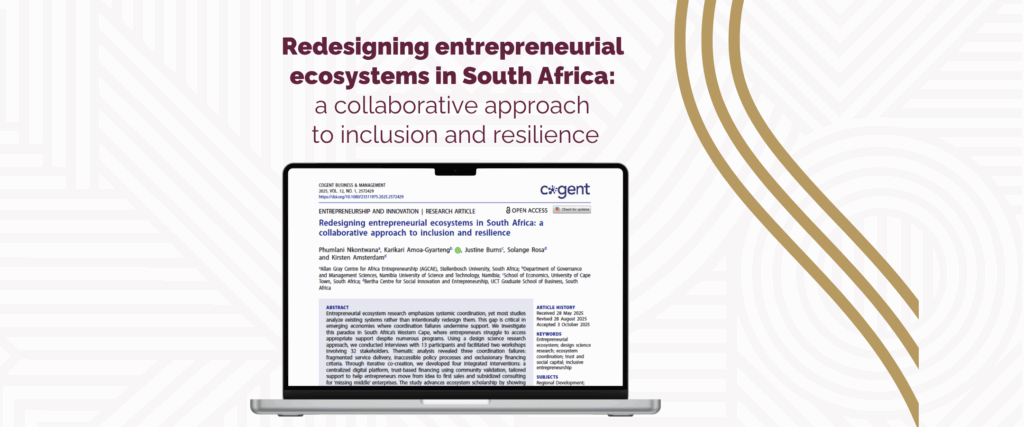
Dr Phumlani Nkontwana is the Founding Director of the Allan Gray Centre for Africa Entrepreneurship. He holds the Allan Gray Chair at Stellenbosch University and is passionate about using ecosystem data to improve or redesign entrepreneurial, business and innovation ecosystems in South Africa and other parts of Africa.